


Capital project owners carry the ultimate accountability.
Capital project owners carry the ultimate accountability.
You are responsible for the capital dollars, funding approvals, public scrutiny, risk exposure, and long-term asset performance. Yet many owners still rely on contractor-controlled systems, spreadsheets, email threads, and disconnected drives to manage complex programs.
If you are accountable for the outcome, you need infrastructure built for the owner role—not borrowed from someone else’s workflow.
Below are eight reasons why capital project owners need their own PMIS.
| Reason | The Risk Without It | What an Owner-Focused PMIS Delivers |
|---|---|---|
| 1. The Owner’s Role Is Broader Than Construction Management | Contractor tools ignore governance, due diligence, and board accountability. | A system structured around the owner’s full lifecycle responsibility. |
| 2. Spreadsheets Don’t Create Governance | Manual updates, version confusion, approval gaps. | Embedded workflows, structured approvals, audit-ready logs. |
| 3. Cost & Schedule Overruns Are Common | Late risk detection and unclear financial exposure. | Real-time budget visibility and contingency tracking. |
| 4. Owners Need a Process Spine | Process lives in people’s heads; outcomes vary by PM. | A structured lifecycle workflow with defined accountability. |
| 5. Litigation Requires a Defensible Record | Scattered documentation during audits or claims. | Centralized correspondence and decision tracking. |
| 6. Portfolio Visibility Is Critical | Executive blind spots across multiple projects. | Multi-project dashboards and exposure summaries. |
| 7. Institutional Knowledge Must Be Captured | Performance drops when key personnel leave. | Standardized workflows and embedded checklists. |
| 8. Owners Must Maintain Independence | Dependence on contractor systems limits oversight. | Owner-controlled data and independent reporting. |
The Core Issue: Control
Capital projects rarely collapse overnight. They drift off course because visibility weakens, risks are not surfaced early, and governance is inconsistent.
Receiving reports is not the same as having control.
True control means:
- You define the workflow.
- You own the data.
- You see financial exposure in real time.
- You can trace every decision.
- You surface risks before they escalate.
Contractor systems are designed to manage construction execution. Architect platforms manage design documentation. Neither is built to govern the owner’s total responsibility.
That gap leaves owners reacting instead of leading.
The Shift Forward
Forward-thinking capital project owners are moving from:
- Tracking to governance
- Reporting to visibility
- Individual expertise to institutional process
- Reactive oversight to proactive risk management
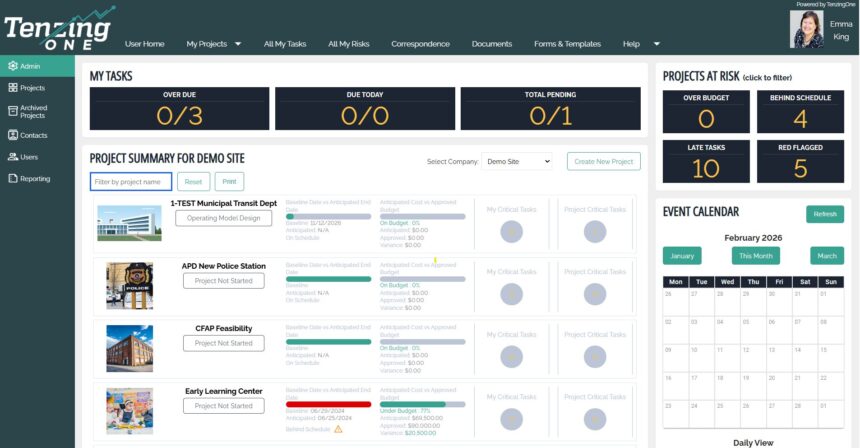
A purpose-built owner PMIS becomes the backbone of that shift. It centralizes documentation, embeds accountability, standardizes workflows, and provides portfolio-level clarity.
If you are responsible for capital dollars, public trust, and long-term asset performance, your infrastructure must reflect that responsibility.
- Your project deserves more than spreadsheets.
- Your governance deserves more than email.
- And your role as Owner deserves its own system.