
"It is not contractor software. It is owner-focused process infrastructure — built for you."

Clarity. Accountability. Confidence.

What Educational Capital Projects Are Up Against

Every capital project an educational institution undertakes — a new school, a campus research facility, a bond-funded renovation, a student housing expansion, a safety upgrade — is carried out in full view of the communities, taxpayers, donors, and governing boards it serves.

Whether you lead facilities for a school district or oversee a multi-campus capital program at a college or university, the challenge is the same: you are responsible for public or institutional capital, complex construction programs, and the governance expectations of boards, legislators, auditors, and the public — often without a project management system built for your role as an owner.

Educational capital programs operate under pressures that most industries never face. Bond referendums carry community expectations. Board meetings are public. Legislative funding is scrutinized. Donor commitments depend on program credibility. Every cost overrun is a headline, and every delayed opening affects students, faculty, and staff.

Yet most institutions still manage these programs the same way they have for decades — through spreadsheets, email threads, shared drives, and contractor-provided reports.

Educational institutions are accountable for every dollar of public or institutional capital spent. When a program drifts off course — through scope creep, unresolved RFIs, undocumented change orders, or delayed decisions — it is the institution, not the contractor, that answers to the board, the legislature, and the community. No current capital project management software on the market provides educational owners with a complete, owner-focused process to address these governance needs. Tenzing One was built to fill that gap.
Built for K-12 Districts and Higher Education Institutions

Educational capital programs share the same core governance obligations — public accountability, board oversight, audit readiness, and multi-project visibility — but each sector faces distinct pressures, funding structures, and reporting requirements. Tenzing One is structured to serve both

K-12 School Districts Colleges & Universities
Primary Governing Body School board, superintendent Board of trustees/regents, president, chancellor
Funding Sources Bond referendums, state funds, and federal grants Capital campaigns, state appropriations, bonds, donor funds, and federal grants
Program Types New schools, renovations, safety upgrades, athletic facilities, and modernization Academic buildings, research facilities, student housing, athletics, deferred maintenance
Key Compliance Obligations Open records, public procurement, and board approval requirements State legislative reporting, accreditation, donor reporting, and public procurement
Schedule Drivers Academic calendar, school opening dates Semester schedule, enrollment targets, donor milestones
Oversight Stakeholders Taxpayers, parents, community members Donors, legislators, faculty, students, and accreditation bodies
Portfolio Scale District-wide campus portfolio Single or multi-campus capital program

Every Element of Your Capital Program, Organized in One Place,

Capital projects in educational institutions are held to a higher standard of accountability. Boards, trustees, auditors, taxpayers, donors, and administrators all expect clear answers to the same questions: Who approved this? When did the decision happen? Where is the documentation? In many organizations, those answers are scattered across spreadsheets, email threads, contractor platforms, and shared drives. Tenzing One changes that. By creating a single destination for approvals, budgets, RFIs, change orders, schedules, risks, documents, and decisions, the platform ensures every project record is complete, traceable, and defensible—giving leadership the visibility and confidence needed to manage capital programs responsibly.


Where This Usually Lives How Tenzing One Changes It
Board approvals scattered in meeting minutes and email threads Every approval captured, time-stamped, and tied directly to the project record
Bond and capital funds tracked across spreadsheets Real-time visibility into how funds are committed and spent across the portfolio
Budgets updated manually across multiple files Live view of approved budgets, commitments, and remaining capital
Change orders buried in contractor systems or email chains Structured review and approval workflow with full contractual documentation
RFIs tracked in email threads Centralized RFI tracking with full response timelines and accountability
Schedules shared as static PDFs Baseline vs. actual schedule visibility with early risk indicators
Risks discussed in meetings but rarely documented Risks documented, assigned, and tracked until resolution
Documents scattered across drives and inboxes Version-controlled document management in a single destination
Key decisions remembered by individuals Searchable record of decisions, correspondence, and governance history
Punch lists managed on paper or disconnected apps Items documented, assigned, and verified through completion

It is time to move from spreadsheets and have a single destination for all capital projects

Purpose Built for Owners, Developed by Owners Representatives.  Don’t rely on GC Systems or spreadsheets to manage your capital projects

What Tenzing One Delivers for Educational Capital Programs

Board, Trustee & Governance Oversight

  • Board-ready and trustee-ready reporting generated from live project data — no manual assembly required the night before a meeting

  • Approval workflow tracking – with automated logs that record who approved what and when

  • Open records and FOIA compliance support — documentation organized, searchable, and retrievable on demand

  • Governance checkpoint monitoring — flags where required reviews or approvals are bypassed before they become a compliance problem

  • Superintendent and president-level dashboards – showing program status across all active projects at a glance

Budget, Bond & Fund Control

  • Real-time fund tracking — committed vs. remaining capital visible across every project in the program, whether funded by bonds, state appropriations, capital campaigns, or grants

  • Proactive change order management — tracks changes from identification through contractual justification, authorization, and cost documentation before approval

  • Exposure flagging — identifies work performed awaiting formal approval, eliminating budget surprises at draw or close-out

  • Budget variance monitoring — surfaces scope and cost risks early, while corrective action is still possible

  • Contingency tracking — keeps a clear view of how and where contingency reserves are being drawn down across the program

Schedule & Delivery

  • Schedule variance tracking – against the approved baseline, with early indicators before delays compound

  • Critical path risk alerts — surfaces schedule threats before they affect school opening dates, semester starts, donor milestones, or accreditation timelines

  • Late task rate monitoring — identifies workflow breakdowns across consultants, contractors, and internal staff

  • Milestone tracking — keeps programs aligned with board-approved and trustee-approved delivery commitments

  • Issue resolution time tracking — from identification through documented close-out

RFIs, Change Orders & Punch Lists

  • Centralized RFI workflow — every RFI logged, assigned, tracked, and closed with a full status trail

  • Change order governance — all stored and accessed via keywords

  • Punch list management — items documented, assigned, and verified through completion before any facility is turned over

  • Full searchability and one-click access to any record across any project in the program

Multi-Campus Portfolio Visibility

  • Single dashboard view across all active construction, renovation, and improvement projects — institution-wide

  • Program-level reporting for leadership presentations without last-minute data reconciliation

  • Risk visibility lead time — issues identified early enough to act, not just report

  • Multi-project exposure summaries so leadership understands the full financial and schedule picture at any point in time

  • Export to PDF and Excel for board packets, trustee reports, donor updates, and audit documentation

Platform & Access

  • Browser-based, no installation required — accessible from any device on any modern browser

  • Role-based access control — board members, trustees, administrators, facilities staff, contractors, and read-only stakeholders each see what they need

  • Automated notifications and overdue alerts keep tasks moving without manual follow-up

  • Cloud-hosted with daily backups and high-availability uptime

  • Single Sign-On (SSO) and Multi-Factor Authentication (MFA) are supported

Structured Workflows for Every Type of Educational Capital Program

One of the most persistent challenges in educational capital management is inconsistency. When each project follows its own approach — different spreadsheets, different documentation practices, different governance habits — program quality varies with whoever is managing it. When staff turn over, institutional knowledge leaves with them. When auditors or accreditors ask questions, the answers take days to assemble.

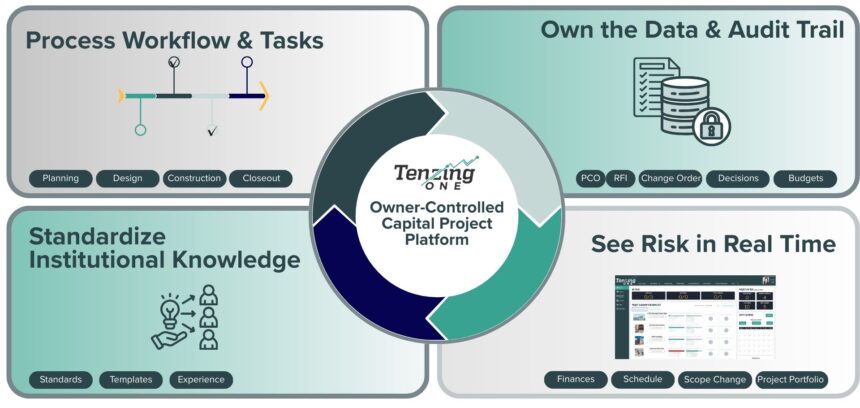
Tenzing One addresses this through its proprietary Process Map — a structured, end-to-end workflow that guides institutional teams through every phase of a capital project, pre-loaded with templates, checklists, advisories, and governance steps built from decades of educational project experience.

What Lives Inside Every Process Map Task

Each task in Tenzing One’s Process Map comes pre-loaded with everything your team needs:

  • Embedded templates and checklists — nothing built from scratch, no reinventing the wheel

  • Built-in advisories — flags decisions that require owner attention before the window closes

  • Cost and schedule elements connected directly to the task

  • Risk entries that surface exposure as soon as it is identified

  • Communication and decision history stored inside the task — not buried in someone’s inbox

Instead of hunting through email chains or shared drives for the right document version, everything lives in one structured environment. Your team always knows what comes next, who owns it, and what approval is required to proceed.

Templated Workflows by Project Category

Tenzing One’s Process Map can be configured with templates tailored to the specific governance and oversight requirements of each development project type. Each template preserves core workflow discipline while reflecting the distinct phases, stakeholder touchpoints, and risk profile of that asset class.

Why Process Consistency Matters at Scale

When every project category runs on its own templated workflow, your institutional knowledge stops living in people’s heads and starts living in your system. If a project manager leaves mid-development, the process does not leave with them. If a lender requests documentation at draw, it is organized and accessible. If you are scaling from three projects to ten, the governance structure scales without requiring additional headcount.

The Process Map can also be customized to reflect your organization’s internal terminology, approval structures, and governance requirements — so your standard operating procedures are embedded directly into the workflow, not documented in a manual that no one opens.

See the Process Map in Action

“With the Process Map in place, owners gain the confidence of knowing their projects are fully under control — not just in theory, but in daily practice.”

Built by Owners' Reps. Designed for Owners.

Most construction project management software was designed from the contractor’s perspective — built to manage field execution, coordinate subcontractors, and track work in place. That is useful for your general contractor. It is not built for you.

Tenzing One was developed by a team of owners’ representatives with 40 years of capital project delivery experience and more than 10,000 projects across public, private, and institutional sectors. The platform encodes the processes, governance structures, and oversight disciplines that experienced owners’ representatives apply on major programs — and makes them available to every developer managing a portfolio, regardless of team size.

The result is a capital project management system that understands what a property developer actually needs: early signals, structured documentation, consistent process, and the ability to report to investors, lenders, and partners with confidence — without assembling the data the night before.