

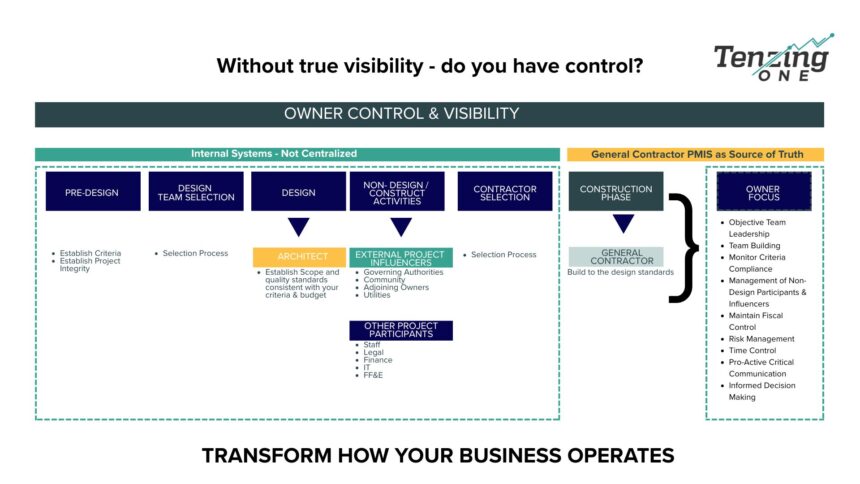
The diagram every Capital Project Owner needs to see.
Capital project owners need their own digital backbone for planning, execution, and governance; relying on your general contractor’s PMIS as the “system of record” is a structural risk that erodes visibility, control, and long-term value.
Why digital transformation is now non-negotiable
Capital projects have quietly become digital businesses in their own right: data, decisions, and documents drive outcomes just as much as concrete and steel. Yet many owners still run projects through fragmented internal systems—email, spreadsheets, legacy finance tools—while letting the contractor’s PMIS act as the de facto source of truth. That gap between how your organization works and how your projects are controlled is the core problem digital transformation must solve.
A modern, owner-centric platform brings together predesign, design, procurement, construction, and closeout into one environment, with structured workflows and auditable data. It lets you govern the project the same way you govern the business: clear standards, defined accountability, and real-time information to make informed decisions.
The hidden risks of using the GC’s PMIS as “source of truth”
When the general contractor’s PMIS becomes the project’s primary system of record, you are effectively outsourcing visibility and control to a party whose incentives are not fully aligned with yours.
- Limited transparency across all participants
GC platforms are built around construction execution, not the full ecosystem of staff, legal, finance, IT, FF&E, governing authorities, utilities, community groups, and adjoining owners. Critical owner activities—approvals, stakeholder commitments, risk registers, business case assumptions—often live outside the GC’s system in emails, shared drives, or individual desktops.
- Data filtered through the GC’s lens
The GC controls what is captured, how it is coded, and what is reported. Change orders, contingency usage, and schedule updates are visible, but the underlying decision trail (who decided, based on what criteria, and with what alternatives) is frequently opaque. This makes it difficult to challenge assumptions, investigate overruns, or learn systematically from each project.
- Misalignment with owner governance and fiscal control
Owners are responsible for maintaining project integrity, fiscal control, risk management, and time control across non‑design and non‑construction activities as much as the build itself. The GC’s PMIS is not designed to manage internal approvals, capital planning workflows, funding releases, or compliance with internal policy and governance frameworks. That leaves finance and legal teams stitching together their own view from partial data.
- Fragmented “truth” across internal systems
In many organizations, the GC’s PMIS holds construction data, while internal systems for finance, legal, IT, and FF&E sit on disconnected platforms with no central project spine. The result is competing versions of reality: one in the contractor’s environment, another in your ERP, and a third living in ad‑hoc spreadsheets and inboxes. When something goes wrong, everyone spends days reconciling rather than responding.
How GC‑centric PMIS reduces owner visibility and control
True control depends on true visibility: if you cannot see the whole project, you cannot meaningfully lead it.
- Incomplete lifecycle coverage
The GC’s PMIS primarily spans contractor selection and the construction phase; it does not natively cover pre‑design, design team selection, concept design, feasibility, or the broad set of non‑design/construct activities that define your business case and stakeholder commitments. Key decisions made upstream never flow into downstream execution in a structured way.
- Blind spots around external influencers
Governing authorities, utilities, community stakeholders, and adjoining owners often drive schedule, scope, and risk—but they are “outside the fence” of the GC’s system. If their commitments, permits, and constraints are tracked informally or in a separate tool, you lose the ability to see how a single regulatory delay cascades across budget, contingency, and operational readiness.
- Weak control of non‑design participants
Staff, legal, finance, IT, and FF&E teams make decisions that affect cost, schedule, and quality just as much as field changes. Without an owner platform that captures their workflows, approvals, and dependencies, there is no single, auditable trail tying their actions to project outcomes. Accountability becomes personal rather than systemic.
- Reactive instead of proactive leadership
When visibility is delayed or partial, you lead by reacting to contractor‑generated reports rather than by monitoring criteria compliance in real time. Pro‑active critical communication—seeing risk early, escalating decisions, re‑sequencing scope—requires a consolidated, owner‑controlled view of data that GC systems are not built to provide.
What owner‑led digital transformation looks like
Digital transformation for capital project owners is not “going paperless” or buying another point solution; it is about establishing an owner‑centric project backbone that spans the entire lifecycle.
- A central owner system of record
All phases—pre‑design, design team selection, design, non‑design/construct activities, contractor selection, construction, and closeout—are orchestrated in a single platform under owner governance. The GC’s PMIS becomes a contributing system, not the master source of truth.
- Embedded criteria, standards, and integrity
Project criteria, design standards, budget frameworks, and risk thresholds are captured digitally at the outset and monitored throughout delivery. Scope and quality standards established with the architect are connected directly to change, procurement, and commissioning workflows so deviations are visible immediately.
- Structured collaboration across all participants
External influencers (authorities, utilities, community stakeholders) and other project participants (staff, legal, finance, IT, FF&E) are integrated into workflows with defined roles, SLAs, and data responsibilities. Instead of emailing documents into a void, each participant works through a shared environment with transparent status and dependencies.
- Owner‑focused leadership and decision‑making
Objective team leadership, team building, compliance monitoring, risk management, time control, and fiscal control become measurable because the underlying events and decisions are captured in one place. Executives can see how today’s decision on scope or phasing impacts future operating budgets, stakeholder satisfaction, and portfolio risk.
Transforming how your business operates
The real payoff of digital transformation is not just better projects; it is a fundamentally better business. When every capital project runs through an owner‑controlled platform, you can compare performance across assets, teams, markets, and delivery models using consistent data. Lessons learned stop living in closeout binders and start shaping the next generation of investments.
You gain the ability to maintain fiscal control, manage risk proactively, and make informed decisions grounded in real‑time information rather than lagging reports. Most importantly, you stop surrendering control of multimillion‑dollar assets to systems you do not own, and instead build a digital capability that matches the strategic importance of your capital program.
If your capital projects are still running on your contractor’s systems and a patchwork of internal tools, now is the time to take back control. Start by mapping where your “truth” really lives today, then define the owner‑centric workflows and visibility you need across pre‑design, design, non‑construction activities, and construction.
Ready to explore what an owner‑led digital backbone could look like for your portfolio? Schedule a strategy session with our team to assess your current state, identify risk and visibility gaps, and outline a practical roadmap to transform how your capital projects – and your business – operate.
Reach out to info@tenzingone.com to learn more