


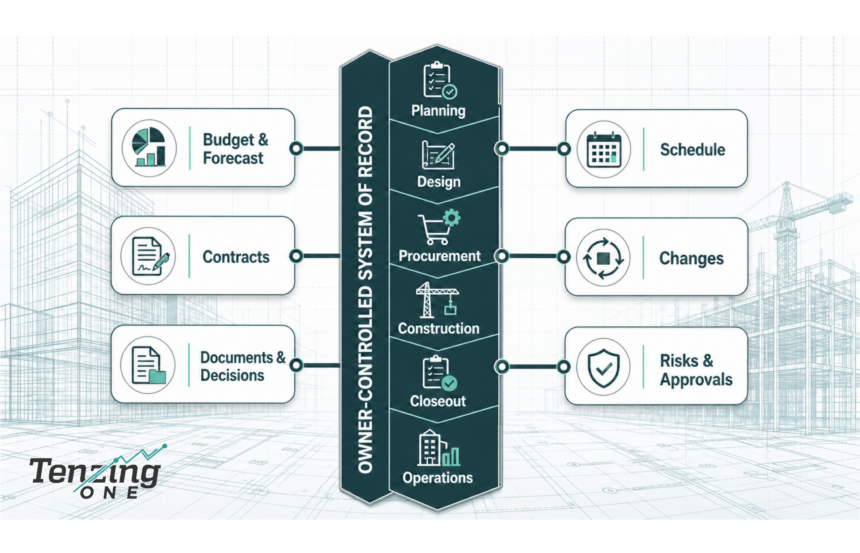
Why Every Capital Project Needs an Owner-Controlled System of Record
Capital projects generate an extraordinary volume of information: budgets, schedules, contracts, drawings, RFIs, submittals, meeting minutes, change orders, pay applications, field reports, emails, and decisions. The problem is rarely a lack of information. The problem is knowing which information is current, complete, and trustworthy—and whether the owner can access it when it matters.
That is why an owner-controlled system of record is essential.
An owner-controlled system of record gives the owner and their representative one authoritative place to manage the project’s key information, processes, approvals, and history. It is not simply a document repository or another dashboard. It is the operational record of how the owner’s project is being governed.
The Project Record Should Belong to the Owner
On many projects, the contractor’s platform becomes the default home for project information. The contractor may manage RFIs, submittals, change documentation, meeting minutes, and schedules in its preferred system. This can be convenient during construction—but it creates a fundamental problem.
The owner does not control the record.
If the contractor controls the platform, the owner may have limited visibility into the data, inconsistent access to reports, and no guarantee that the full project record will remain available after closeout. When questions arise months or years later, the owner may be forced to reconstruct the story through old emails, exported reports, individual spreadsheets, or archived files.
That is not project control. It is dependence.
An owner-controlled system ensures that the owner retains the project’s institutional memory from planning through design, construction, closeout, and beyond.
Visibility Is Not the Same as Control
Many teams believe they have control because they receive status reports or have access to a contractor’s project platform. But visibility alone is not enough.
True control means the owner can:
- Establish the workflows that govern approvals, decisions, and changes.
- Define the information required for consistent reporting.
- Maintain a complete, accessible history of project activity.
- Compare performance across projects and programs.
- Preserve records when team members, consultants, or contractors change.
- Create a defensible record of how decisions were made.
A weekly report may show that a project is “green.” An owner-controlled system of record allows the owner to ask why—and see the data, decisions, risks, commitments, and unresolved issues behind that status.
Project Control Depends on a Single Source of Truth
Without a central system, capital project information becomes fragmented. Budget information may live in one spreadsheet, schedule updates in another system, meeting notes in email, change documentation in a contractor platform, and executive updates in slide decks.
This fragmentation creates predictable risks:
- Different stakeholders work from different versions of the budget.
- Change decisions are made without a clear record of their cost or schedule impact.
- Important approvals are buried in email chains.
- Executive reporting is assembled manually and may be outdated by the time it is reviewed.
- A project manager’s departure creates a gap in knowledge and continuity.
- Disputes become harder to resolve because the project history is incomplete or dispersed.
An owner-controlled system of record brings those threads together. It gives every stakeholder a shared operating environment while preserving the owner’s authority over the information and process.
The goal is not to create more administration. The goal is to reduce rework, eliminate ambiguity, and make decision-making faster and more reliable.
Better Process Produces Better Decisions
Capital project problems rarely appear all at once. They develop gradually: an increasing number of pending changes, a contingency balance declining faster than expected, a schedule milestone slipping without a clear recovery plan, or a growing list of unresolved decisions.
When information is scattered, those signals are easy to miss.
A structured system of record makes emerging issues visible by connecting the underlying project processes. For example, an owner should be able to see:
- The current approved budget, forecasted cost, and remaining contingency.
- Open and approved changes, including their schedule implications.
- Pending decisions that could affect cost, schedule, or scope.
- Risks, responsible parties, and mitigation plans.
- Milestone performance across the project lifecycle.
- The documentation supporting a major decision or approval.
This is the difference between reporting on what happened and managing what happens next.
Continuity Matters More Than Ever
Projects often span years. During that time, owners may change leadership, owner’s representatives may rotate staff, designers and contractors may shift teams, and institutional knowledge can disappear.
A well-run project should not depend on one person’s inbox, personal spreadsheet, or memory.
An owner-controlled system preserves the record of the project: what was decided, who approved it, why it mattered, what information was available at the time, and how it affected the budget, schedule, and scope. It allows a new project manager or executive to understand the project without starting from scratch.
For owners’ representatives, this is especially valuable. A consistent system creates continuity across teams and projects, supports more reliable client reporting, and helps demonstrate that the owner’s interests have been protected throughout the project.
Control Strengthens Accountability
An owner-controlled system of record does not replace the contractor’s construction management tools or the design team’s workflows. It creates the owner’s independent layer of governance.
Every stakeholder still has a role. The contractor manages construction. The architect manages design. Consultants provide specialized expertise. The owner’s representative coordinates, monitors, and protects the owner’s interests.
The owner’s system of record brings these activities into a clear framework of accountability. It creates consistent expectations for documentation, approvals, reporting, and escalation—without relying on any one project participant to define the terms of control.
That structure helps teams collaborate more effectively because the process is clear, the record is shared, and the owner’s priorities remain visible.
The Bottom Line
A capital project is too important to be governed through disconnected spreadsheets, email archives, and systems controlled by other parties.
An owner-controlled system of record gives the owner the ability to maintain continuity, standardize process, preserve critical information, and make informed decisions throughout the life of the project. It turns project data into a reliable management tool—not just a collection of files and reports.
For owners and owners’ representatives, the question is straightforward:
If you do not control the project record, do you truly control the project?
Reach out to info@tenzingone.com to learn more